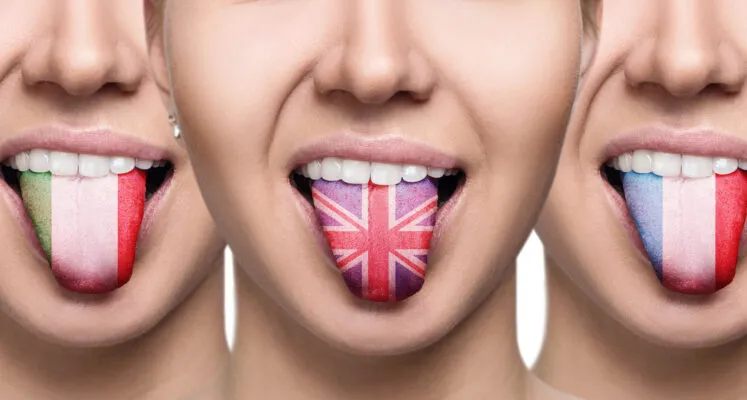

We speak the way we feel. Or do we only feel the way we speak? The connection between the grammar of a language and emotional culture seems evident, yet it has been the subject of research and intense debate for decades. Can neurology provide clarity?
People learning Japanese face three tough challenges: A vocabulary that bears no relation to our language, a completely different writing system, and very specific grammar rules. Take “Keigo”, for example, an honorific form of Japanese used to show respect, politeness, and formality towards others on formal professional occasions. Different verb forms are based on the hierarchical difference between the speaker and the person being addressed. Nowadays, the fine art of Keigo is more of an elite phenomenon, but it is not extinct. The distinction between the informal “du” and the formal “Sie” in German (or “tú” vs. “usted” in Spanish) seems almost like a joke compared to this system.
Whether the legendary politeness in Japan is an expression of emotion or its exact opposite is probably in the eye of the beholder. However, it is quite obvious that a grammatical idiosyncrasy such as Keigo says a lot about Japanese culture and its social conditions. But does this apply to every language? Is grammar always a reflection of culture and its handling of emotions?
Culture and emotion have an impact on language.
One thing is sure: Japanese politeness forms are not unique. In Turkish, for example, there are specific modal forms that support indirect, judicious communication. There is a verb form that expresses necessity or obligation, another that formulates a suggestion or wish, and yet another that indicates considerate distancing. This remarkably nuanced grammar probably arose from a delicately balanced social system.
Here is another example: In Russian, there are several terms that describe sadness in all its facets. This multiplicity is also entrenched in the grammar itself. Depending on the case form and syntactic structure, speakers can very precisely express the duration, intensity, and direction of sadness.
Book a free initial analysis
Take advantage of our free initial analysis worth €900 for your next translation project. We will show you potential savings and how to optimize your translation processes.
I versus we: When language reflects society
It is also interesting to compare the grammar of collectivist and individualist societies (as vague as this distinction may be). In German and English, it is common to use the personal pronoun “I” to formulate sentences. Japanese and Koreans tend to avoid “I” and prefer to replace it with “we” or omit the subject altogether. Another variant is the passive or indirect formulation.
Grammar is particularly important when the content of the verbal or written communication could lead to conflict. In German or English, it is completely normal to say things like “I see it differently” or “That’s not right”, even to superiors. In these types of situations, Asian languages tend to use grammatical constructions that form questions or paraphrases.
However, the question remains: Do these sentence structures arise from the emotional state of a group? Or, conversely, does grammar influence the emotional state of the speakers? Or is it possible that both statements are true?
A hypothesis that is still the subject of intense debate today.
In the mid-twentieth century, the Sapir-Whorf hypothesis gained popularity. It dealt with precisely this question: Does language influence people’s worldview – or is it the other way around? Formulated as the “principle of linguistic relativity”, the idea states that different languages divide and categorize the real world in different ways. According to this theory, each culture has its own experiences and is subject to its own environmental conditions. It pours the most important ones into linguistic concepts, ignoring those that are less important. This creates a permanent correlation between society and its language. The same applies to facial expressions and gestures, which have a similar effect as grammar.
The hypothesis is still hotly debated today. Linguist Benjamin Lee Whorf himself made it contestable by citing several examples that did not hold up. For example, he stipulated that the Hopi language does not offer a way to describe temporal sequences, which is not true. He also claimed that the Inuit have a myriad of terms for snow, which is still circulating today despite also being untrue.
Toward the end of the last century, the hypothesis received a new boost. The more small, previously unknown languages were discovered and analyzed, the clearer it became how extremely different grammar can be. However, research into the correlation between emotion and grammar increasingly moved away from conventional linguistics and became the focus of psycho- and neurolinguistics.
Anger, joy, sadness: Traces of language in the brain
In 2025, Chinese researchers conducted an interesting experiment. They showed bilingual test subjects pictures that they had to name alternately in Chinese and English. At the same time, they scanned their brain activity using MRI. It turned out that the language-specific regions of the brain received more blood flow when the test subjects were using the dominant Chinese language. For the authors of the study, this was an indication that the native language is not only more accessible, but also deeply rooted in culture.
In another study this year, an American team conducted the following scientific experiment to investigate the connection using MRI. They showed test subjects cards with emotionally charged terms that evoke strong feelings such as anger, joy, sadness, etc., and observed the resulting release of neurotransmitters in the brain. Surprisingly, the study also activated brain regions that had previously not been associated with language processing. Apparently, language is deeply embedded in the neural architecture.
The study authors drew an almost emotional conclusion from the results: “[…] these results support the idea that the ancient systems that evolved to keep us alive by evaluating positive and negative stimuli in the environment may also extend to the processing of words, which are probably just as crucial to human survival.” You simply can’t put it any better than that.